





Will a Pet Ramp Work for Bed Access?
Measure the real mattress height and bedside route, then confirm the option details before relying on a pet ramp.

Questions Before You Choose
My bed height is not listed
Keep the measurement unknown and request the exact version height rather than inferring it from a step count.
There is little space beside the bed
Measure the approach and return route together. A floor-level rest or another format may be more practical than a blocked walkway.
My pet is suddenly reluctant to jump
Ask a veterinarian about the change before relying on a home access aid.
The Full Answer
Bed access is a very specific home problem. A pet may want to sleep beside you but hesitate before one large jump, while the room leaves little space for a bulky aid. The Gentle Slope Pet Ramp can be worth considering when a gradual route fits the measured bed, the upper end meets the sleeping surface, and your pet can approach and leave without pressure. It is not a universal answer, and the current listing does not state its total height, length, width, slope angle, or load limit.
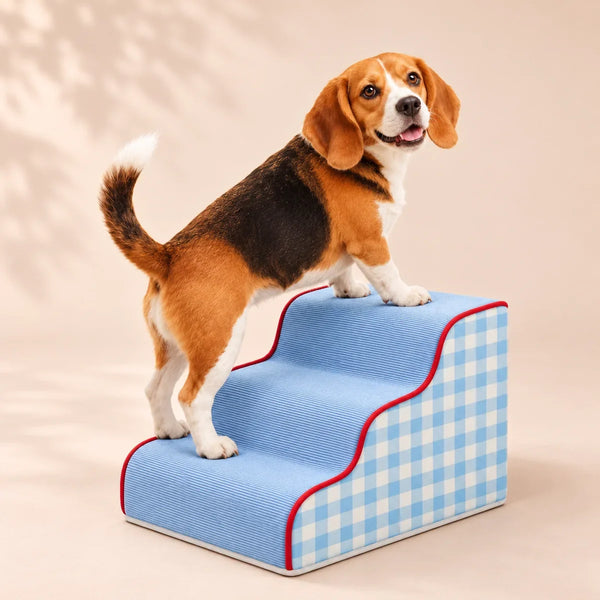
Start with the real bedside scene. Measure the floor to the top of the mattress, note bedding that changes the height, and look at the floor in front of the bed. Then ask whether the ramp can stay flat and aligned when the bed is made, the room is dark, and someone needs to walk past. The product is listed with 2-step, 3-step, and 4-step options, a high-density foam body, a plush cover, and a non-slip base. Those facts still need to be matched to your room.
Measure the bed you actually use
Measure where your pet will step across, not only the bed frame. A thick comforter, topper, or pillow may make the landing higher than the frame suggests. If you change bedding often, measure the usual versions and keep the highest routine in mind. A ramp that meets a bare mattress may leave a gap when the bed is dressed.
Write down the measurement rather than selecting a step count by appearance. The 2-step, 3-step, and 4-step labels tell you which options are available, not the physical height of each option. The current Product record does not provide a height chart, step rise, or ramp length. Ask for those details before ordering if the difference between your bed and the ramp top would affect the final step.
Check the upper transition from the side. The top should sit close enough to the mattress that your pet does not need to leap across a gap. It should also leave a clear place to step onto the bed without catching bedding or sliding sideways. If you cannot verify that transition, a floor-level bed or another access format may be a better choice for now.

Protect a straight bedside approach
A bedside route needs clear floor depth. Move laundry baskets, shoes, cords, and loose rugs away from the lower end. Give your pet a straight enough line to approach without squeezing between the ramp and a wall. Leave room for a pause and a turn at the bottom instead of treating the lower end as a doorway.
Look at both sides of the ramp. Your pet may step off before reaching the bed, especially during early use. A nightstand corner, radiator, or hard object beside the route can make a small hesitation more consequential. Keep the landing and the path back to the floor visible, and supervise until you understand how your pet moves through the space.
Consider the human route too. If the ramp blocks the only path around the bed, the household may move it each night and forget to return it flat and flush. A route that works only when the room is perfectly arranged is not a strong daily fit. Measure the furniture and the walkway together.
Match the choice to the pet, not the label
A small or older dog may prefer a gradual route, but age and size alone do not establish suitability. Observe how your pet walks on a clean, dry floor. Notice whether the animal can stop, turn, and step over a small threshold without scrambling. These observations help you decide what to ask about the ramp, but they do not diagnose pain or determine a medical plan.
Some pets prefer a continuous surface. Others understand separate stairs more readily. Some will use neither if the object is placed too close to the bed or introduced during a busy bedtime. Keep a floor-level resting place available so your pet can choose. Do not make bed access depend on a forced climb while you are still deciding whether the route is comfortable.
If your pet has suddenly stopped jumping, seems stiff, limps, cries, or changes gait, speak with a veterinarian. If the pet is recovering from an injury or has a diagnosed condition, follow professional instructions about home access. A bed ramp may be one part of a household plan, but it is not a treatment, a diagnosis, or a guarantee of pain-free movement.
Check the first and last steps
The first step tells you whether the lower end feels approachable. Keep your hands relaxed and let your pet sniff or walk around it. A small treat beside the ramp can help the animal investigate, but do not use food to pull a pet farther than it wants to go. A voluntary pause is more useful than a fast climb under pressure.
The last step tells you whether the bed transition makes sense. Watch whether your pet steps across naturally or stretches, scrambles, or jumps from the top. Then watch the way back down. A pet that reaches the bed but cannot return with the same calm movement does not have a finished route.
Change only one thing at a time. Keep the bed, ramp position, and session length steady before trying a different step count. If you move the ramp and change the bedding at once, the result will be hard to understand. End a session before your pet becomes tired or frustrated, and try again only when the room and the animal are calm.
Never pull a collar or push a body up the ramp. Do not lift a pet onto the bed simply to prove that the top reaches it. If you need hands-on support, ask a qualified professional how to handle the individual animal, particularly when pain or recovery may be involved.
Make the bedside routine easy to maintain
The ramp has to remain usable after the first few nights. The current Product description states a plush cover, a non-slip base, and a removable washable cover. Follow the product's care directions, let the cover dry fully, and return the ramp to the same position on a clean, dry floor. Do not add a slippery blanket over the walking surface just to make it look familiar.
Before bedtime, check that the base is flat and the upper edge is still aligned with the mattress. Check again after changing sheets or moving the bed. If the floor becomes damp or cluttered, pause the route until it is clean and dry. The phrase non-slip base describes a product feature, not an unlimited guarantee on every floor or situation.
Think about storage. If the ramp must be carried away every morning, decide where it will go and whether a tired household can set it up correctly at night. A low floor bed or a different access format may be more useful if the equipment cannot stay safely positioned. Convenience is part of the fit, not an afterthought.
Know when the bed route is not a fit
Do not choose a ramp when the destination height cannot be matched, the top leaves a gap, the room has no clear approach, or the lower end sits in a human walkway. Do not assume a 4-step option reaches a tall bed. Without a confirmed height, length, width, and load limit, the responsible choice is to request the missing information.
Pause if your pet freezes, scrambles, repeatedly jumps from the side, shows distress, or refuses to return down. Pause if you cannot supervise early use or if the bed position changes too often to keep the route stable. A product can be well suited to one bedside scene and wrong for another.
When the need is medical, involve the right professional before making the ramp part of a recovery routine. A new reluctance to jump can signal a problem that deserves assessment. Do not let a search for a dog ramp for bed replace a conversation about the pet's health or the household changes a veterinarian recommends.
Choose the bedside plan you can repeat
Before deciding, record the mattress height, the space in front of the bed, the space beside it, the return path, your pet's movement, and the product specifications still missing. If the measured scene remains practical, view the current ramp options. If you are comparing formats, read the ramp versus stairs comparison.
Choose among Banana Yellow, Sky Blue, Smoke Gray, and Khaki only after the destination and route make sense. The listed colors can fit the room, but they cannot answer whether the upper end meets your mattress. Step count is also only a starting point until the exact physical details are confirmed.
Keep a floor-level option available, introduce the route slowly, and supervise both directions. If the ramp makes bedtime calmer and your pet can approach, climb, pause, and leave without pressure, it may have a place beside the bed. If it creates new uncertainty, keep the simpler option and ask for qualified help.
Bed access is a daily route, not a one-time photograph. The right answer is the one that remains clear when the bed is made, the floor is busy, and your pet wants to come back down. Measure first, keep the unknowns visible, and let the real bedside response decide.
Common Questions
How do I know whether a ramp will reach my bed?
Measure the floor to the mattress surface and confirm the exact height, length, width, and load limit of the version you are considering. The current 2-, 3-, and 4-step labels do not provide those measurements.
What should I check around a bedside ramp?
Leave a clear approach, landing, and return route. Keep the base flat on a clean, dry floor, align the top with the mattress, and supervise until your pet's movement is familiar.
Is a pet ramp a treatment for a mobility problem?
No. A new reluctance to jump, stiffness, limping, pain, or changed gait deserves veterinary advice. A ramp cannot diagnose or treat the cause.
Is It Right for Your Pet?
Compare related questions for this product and use case.


Gentle Slope Pet Ramp for Beds & Sofas
- Pet Ramp for Beds, Sofas
- Gentle Slope Access
- 2-, 3- or 4-Step Heights
- High-Density Foam Core
