







Short answer: A 2026 study of four ancient dog genomes from southern Korea found broad genetic affinity with dingoes and New Guinea singing dogs in analyses that also included wolves. When researchers compared dogs without wolves, however, the ancient Korean samples separated from those two groups. The authors interpret that pattern as evidence for more than one East Eurasian dog lineage, not as proof that one group directly descended from the other.
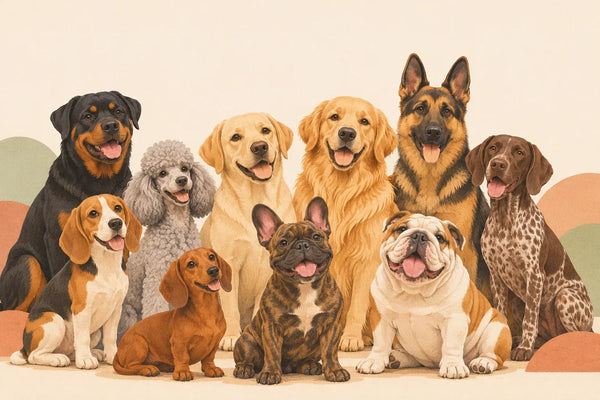
Image note: The illustration is conceptual. It does not depict an excavated specimen, a particular modern breed, or a measured family tree.
What did the study examine?
The researchers analyzed four archaeological dogs from two sites on the southern Korean Peninsula. Three came from Neuk-do, in Sacheon, and date from the third century BCE to around the beginning of the Common Era. One came from Bonghwang-dong, in Gimhae, and dates to the fourth through sixth centuries CE. These remains offer a small, geographically specific window into dog history; they are not a census of ancient Korea.
The team compared the ancient genomes with published dog and wolf genomes using several methods, including phylogenetic trees, outgroup-f3 statistics, principal component analysis (PCA), and f4-based tests. These methods look at different patterns of genetic similarity and shared ancestry. They can help researchers compare populations, but none turns a few ancient genomes into a complete record of how dogs moved or mixed.
Genome coverage was low for all four specimens: the reported mean values were 0.50×, 0.73×, 0.64×, and 0.30×. Lower coverage means that, on average, fewer sequence reads cover each position in the genome. The authors note that individual comparisons were often statistically weak, so they pooled the Korean samples for one of their population-level analyses. That is an important reason to read the result as an early population-history signal rather than a precise account of every dog represented at either site.
Why did the comparison produce two different views?
In analyses that included wolves, the ancient Korean dogs showed broad genetic affinity with dingoes and New Guinea singing dogs. In the dog-only PCA, the ancient Korean samples and the dingo and New Guinea singing dog samples occupied separate clusters. The paper's authors interpret the contrast as consistent with at least two East Eurasian dog lineages.
| Comparison | Reported pattern | What it can support | What it cannot establish alone |
|---|---|---|---|
| Dogs and wolves included | Broad affinity between the ancient Korean samples and dingoes or New Guinea singing dogs | A signal of genetic similarity in the sampled comparison | Direct descent, a named migration route, or breed identity |
| Dog-only PCA | The ancient Korean samples separated from the dingo and New Guinea singing dog samples | A pattern consistent with distinct population lineages | A complete map of East Asian dog diversity or a formal breed boundary |
Three useful insights from the evidence
1. Genetic affinity is not the same as a direct ancestor
Two groups can share parts of their population history without one being the direct source of the other. A broad affinity in one comparison does not identify a single route, date, or direction of movement. The dog-only result adds a different perspective: similarities can sit alongside meaningful differences when the comparison is narrowed to dogs.
2. A lineage is a population-history idea, not a modern breed label
The study does not show that today's Jindo, Donggyeongi, or Sapsal dogs descend directly from any of these four individuals. Nor does it assign the ancient remains to a modern breed. The authors discuss relationships among sampled populations; connecting those patterns to a living breed would require appropriate genomes from more ancient and modern dogs, analyzed with a design that can test that specific question.
3. Four genomes can reveal a question without settling the map
Ancient DNA is difficult to recover in high coverage, and the four specimens come from only two sites in southern Korea and several centuries of history. The findings are informative because they provide genomic evidence from archaeological dogs in a region and period with limited ancient sampling. Their value is not that they settle the whole history of Korean or East Eurasian dogs; they help show what additional samples should be compared next.
What remains uncertain?
This is one peer-reviewed study, not a systematic review. Its small sample cannot represent every dog living in the Korean Peninsula, and the low genome coverage limits the precision of some individual comparisons. The paper also reports additional wolf-related and dog-related gene-flow signals. Because the article's summary and results do not give fully matching numerical descriptions for one ancestry estimate, this brief keeps that finding qualitative and does not repeat a percentage.
The study does not determine where dog domestication began, date the first arrival of dogs in Korea, or reconstruct a continuous migration path. The authors say that more ancient Korean dog genomes, including Neolithic-era samples, are needed to clarify regional ancestry history. Those future samples could help distinguish shared ancestry, later gene flow, and separate population histories.
Bottom line
The ancient Korean genomes show why ancestry is often better understood as a set of relationships than as a simple family tree. The study found broad affinity with dingoes and New Guinea singing dogs in a comparison including wolves, while a dog-only analysis separated the sampled groups. That is evidence for a complex East Eurasian dog history, not proof of direct descent or a link to a particular modern breed.
Sources
- Kim H, Kim S, Yu A, et al. Ancient East Asian dog lineage is revealed by genome of ancient Korean dogs. PLOS ONE. 2026;21(5):e0346864. Published May 6, 2026.
- Supplementary Table S3: Radiocarbon dates from the Bonghwang-dong and Neuk-do sites.