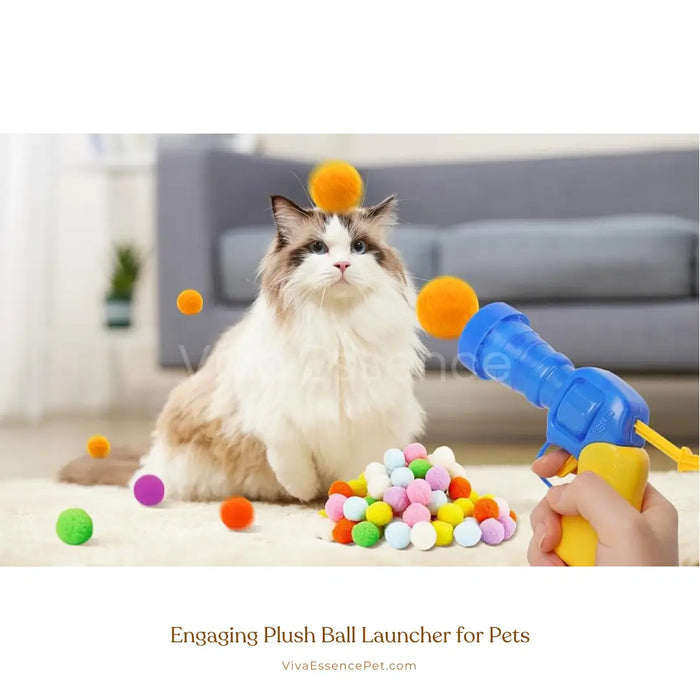








In a four-week trial of 92 privately owned cats, owners in both groups reported a decrease in most target behaviors. The study found no significant difference between cats assigned food puzzles and those assigned non-food toys. The abstract describes only these two active groups, so the decline alone cannot tell us whether either activity caused it.

What question did the study ask?
The researchers compared two ways of adding activity around feeding: food puzzles and non-food-related toys. The paper notes that cats use attention to communicate with people. An attention-seeking label, on its own, does not mean a behavior is a problem.
The study focused on a specific group: 92 privately owned cats with no or limited outdoor access. Their owners reported that each cat showed at least one of the study's predefined attention-seeking behaviors every day. The cats were randomly assigned to one of two groups: 44 to food puzzles and 48 to non-food toys.
What the researchers measured
For four weeks, owners were asked to use the assigned items at feeding times and report the prevalence of the included behaviors each week. The accessible abstract describes weekly owner reports; it does not specify continuous monitoring or independent scoring.
| Study detail | What the abstract reports |
|---|---|
| Species | Domestic cats (Felis catus) |
| Participants | 92 privately owned cats with no or limited outdoor access and at least one predefined behavior reported daily |
| Groups | 44 cats assigned food puzzles; 48 assigned non-food toys |
| Duration | Four weeks |
| Comparison | Two active enrichment approaches used at feeding times |
| Outcome | Owners reported weekly prevalence of the included behaviors |
| Geography | Not stated in the accessible abstract |
The University of Copenhagen authors' affiliations do not tell us where the participating households were located, so this summary does not assign the trial a country. The accessible abstract also does not give calendar dates for recruitment or data collection.

What changed, and what did not?
The abstract reports that most included behaviors decreased over the four-week period in both groups. It also reports no statistically significant difference between the food-puzzle and non-food-toy groups in how much the behaviors decreased.
That answers one useful question: the trial did not show that food puzzles worked better than the toys in this comparison. The accessible abstract does not provide behavior-by-behavior percentages, effect sizes, confidence intervals, or exact test statistics, so there is no sound basis here for adding a precise reduction figure.
Evidence-led insights
1. The trial compared two specific approaches
The trial compared two active forms of enrichment around feeding. It did not test every way a cat might seek attention or compare individual products. The results describe those two approaches in this selected group; they do not rank every toy and puzzle available.
2. No significant difference does not prove equivalence
The paper's abstract reports no significant difference between groups and suggests the approaches may be used interchangeably. A non-significant result by itself is not a formal demonstration that two options are equivalent. The accessible abstract does not report an equivalence margin or a non-inferiority test, so it cannot establish that the effects are identical.
3. The decrease cannot be credited to enrichment alone
The abstract describes two groups that both received an enrichment activity. It does not describe a third group that continued its usual routine without added enrichment. That means the reported decrease over time cannot, by itself, show what would have happened without either activity. This is a design implication, not a mechanism the researchers measured; time, extra owner attention, and reporting expectations remain possible explanations rather than proven causes.

4. The result belongs to a particular sample and a short window
The cats were privately owned, had no or limited outdoor access, and were already reported to show a target behavior daily. The study followed them for four weeks. It does not establish what happens for every cat, for cats without those daily behaviors, or over longer periods.
A careful takeaway for cat households
For cat households, this trial offers no evidence that food puzzles work better than non-food toys. It did not test commercial products or measure individual preferences, so its group result cannot predict which activity a particular cat will choose.
What this summary cannot tell us
This summary is based on the peer-reviewed article record and its public abstract. The linked full-text PDF was not retrievable for this review. The accessible abstract does not provide the complete behavior list, item-level results, exact effect estimates, missing-data handling, recruitment geography, or longer-term follow-up. Those details could change how narrowly the findings should be interpreted, so none are filled in here.
Sources
Hoff A, Lundegaard LSR, Møller-Petersen ML, Nielsen SS, Sandøe P. Dealing with annoying cats: A randomised controlled trial of feeding-time enrichment to reduce attention-seeking feline behaviours. Applied Animal Behaviour Science. 2026;300:107017. Read the article record and DOI or view the University of Copenhagen research record and abstract.
Reported details above are limited to those available in the linked peer-reviewed abstract. The comparison, equivalence, and no-control-group interpretations are identified as design inferences, not as separately measured study results.