


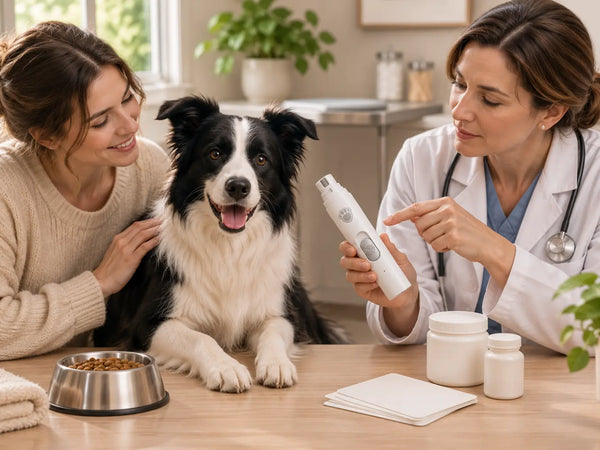






Natural supplements for dogs with pancreatitis require a veterinarian-first review. Natural origin does not establish that a product is suitable for a dog with pancreatitis. Before starting, stopping, or changing any supplement, pause long enough to identify whether your dog may be having an active flare, what diet and medicines are currently in use, and what the complete product label says.
The safest practical path is:
- Establish the current care context. Is pancreatitis suspected, confirmed, active, improving, or a past diagnosis?
- Gather the entire product label. Record the ingredient list, active amounts, guaranteed analysis, calories, serving size, directions, warnings, and quality information.
- Compare the product with the current diet and medicines. A supplement may add fat, calories, nutrients, herbs, or drug-like ingredients that matter to the care plan.
- Ask the veterinarian to review the exact product, dose, timing, and reason for use.
There is no universal natural supplement recommendation for every dog with pancreatitis. Suitability depends on the individual diagnosis, current symptoms, recovery phase, diet, medications, formulation, dose, calories, fat content, and response. Veterinary references place clinical status, possible risk factors, concurrent disease, treatment, and nutritional support at the center of pancreatitis care. The Merck Veterinary Manual guidance on pancreatitis in dogs states that a ration containing less than 20 g of fat per 1,000 kcal should be chosen for dogs with pancreatitis, but that figure is dietary guidance, not a supplement dose or a reason to approve a particular product.
If your dog is vomiting repeatedly, appears painful, is unusually weak, refuses food or water, has ongoing diarrhea, seems dehydrated, collapses, or is worsening after a recent diagnosis, contact your veterinary clinic promptly. Supplement research should not delay assessment of a possible flare.
This guide helps you prepare for that conversation. It does not diagnose pancreatitis, identify a universal list of prohibited ingredients, or provide a general supplement dose.

What should you do before giving a supplement to a dog with pancreatitis?
Pause the supplement decision, assess the dog’s current status, and bring the complete label to the veterinarian before making a change. This applies whether the product is marketed as a probiotic, fish oil, digestive aid, herbal blend, vitamin, mineral product, CBD oil, or another “natural” remedy.
The first question is not “Which supplement is best?” It is “What is happening with this dog right now?”
A dog in an active flare may need prompt veterinary assessment, prescribed treatment, hydration support, pain control, anti-nausea treatment, nutritional planning, or other care. Adding a new product at that point can make it harder to tell whether a change in appetite, stool, vomiting, pain, or energy comes from the disease, the supplement, the diet, or the prescribed treatment.
A dog recovering under veterinary supervision presents a different question. The veterinarian may be monitoring appetite, weight, stool quality, hydration, laboratory values, or tolerance of a therapeutic diet. The timing of any new product matters because changing several variables at once makes the response difficult to interpret.
A dog with a remote history of pancreatitis may still need a careful review. A past episode does not automatically prove that every supplement is unsafe, but it does make the product’s fat, calorie, nutrient, ingredient, and dosing details more relevant.
Use this first-pass decision path:
| Current situation | Practical next step |
|---|---|
| The dog has active or worsening signs such as repeated vomiting, marked pain, weakness, collapse, or refusal of food and water | Contact the veterinary clinic promptly. Do not use a supplement to delay care. |
| Pancreatitis was recently diagnosed or is being treated | Keep the current plan steady unless the veterinarian directs a change. Ask about the product before giving it. |
| The dog is improving but still has a restricted or therapeutic diet | Ask the veterinarian or veterinary nutritionist to assess the product’s fat, calories, nutrients, and timing within that diet. |
| The dog has a past history and is currently stable | Gather the label, current diet, medicines, and reason for use before asking whether the product belongs in the plan. |
| The label does not state active amounts, serving size, calories, or relevant fat information | Treat the missing information as a reason to pause and ask the clinic or manufacturer for clarification. |
The American Veterinary Medical Association household-hazards guidance advises that pets should not receive medications, non-prescription medicines, or dietary supplements unless directed by a veterinarian. That broad safety advice is especially useful here because pancreatitis makes the total care context important.
If you want background on why human products may create extra questions about ingredients, servings, sweeteners, and medication interactions, read why human supplements are not automatically suitable for dogs.
Label review before the veterinary conversation
Use this visible worksheet to identify missing information. Checking an item records what you have gathered; it does not approve the product.
If any key detail is missing, keep the product on hold until the question is resolved with the clinic or manufacturer.
Why does pancreatitis change the supplement decision?
Pancreatitis makes the whole care plan relevant, because diet, symptoms, medicines, calories, fat, and nutrient overlap can affect the decision. A supplement cannot be evaluated in isolation from the dog receiving it.
Pancreatitis is inflammation of the pancreas. The condition can vary in severity, cause, duration, and response to treatment. Some dogs have a single episode; others need longer-term dietary management or evaluation for concurrent problems. The same product may raise different questions for a dog who is vomiting today, a dog who has just resumed eating, and a dog who has been stable for months.
Veterinary guidance from Merck and VCA places nutrition and clinical context at the center of care. VCA’s guidance on nutrition and pancreatic disease in dogs discusses therapeutic low-fat diets, meals, treats, people foods, diet transitions, appetite concerns, and referral to a veterinary nutritionist. Those issues apply to supplements because a supplement can function like a small food or nutrient addition, even when it is sold in a capsule, chew, powder, liquid, or softgel.
Active flare, recovery, and long-term management are different situations
The timing of a supplement question matters. A product that might be considered during stable long-term management may be inappropriate to introduce during vomiting, poor appetite, abdominal pain, or rapid dietary change.
During an active flare, the priority is identifying what the dog needs medically. Pancreatitis can cause gastrointestinal signs that overlap with possible supplement reactions, including nausea, vomiting, diarrhea, reduced appetite, and lethargy. If a new product is introduced at the same time, the clinical picture becomes less clear.
During recovery, the dog may be transitioning back to food or moving from one diet to another. A new supplement can add another change to an already sensitive routine. Ask whether the veterinarian wants the diet and medication plan observed on its own before any optional product is considered.
During long-term management, the conversation may focus on recurrence risk, weight, body condition, dietary fat, nutrient sufficiency, concurrent disease, and whether the product serves a defined purpose. A supplement should have a clear reason for consideration, a known amount, and a monitoring plan.
Diet and fat are central questions
Dietary fat is one reason a label deserves careful review. Merck Veterinary Manual states that a ration with less than 20 g of fat per 1,000 kcal should be chosen for dogs with pancreatitis. That number describes fat density in the ration under the cited veterinary guidance. It does not tell you how much of a particular supplement to give, whether every dog should remain at that level indefinitely, or whether a product with a “low-fat” marketing phrase is automatically appropriate.
A supplement may contribute fat through oils, softgel carriers, animal-derived ingredients, flavor coatings, or other components. The amount may seem small by household standards, yet the veterinarian may need to consider it alongside the complete daily diet, treats, medications, and other additions.
Calories also matter. A chew, paste, powder, or oil can contribute energy even if the label does not present it prominently. If the dog is on a therapeutic diet or has weight-management goals, the product may need to be counted as part of the daily intake.
This is why it helps to bring the current food label and a typical daily feeding record to the appointment. Include treats, table foods, pill pockets, flavored medications, dental products, and supplements already in use. A feeding transition planner can help you record food changes, appetite, stool, and hydration observations for the veterinary discussion, while the veterinarian remains responsible for pancreatitis-specific diet decisions.
Medicines and concurrent conditions change the question
A supplement may affect the conversation because of its ingredients, its effect on appetite or stool, its nutrient content, or its possible interaction with a prescribed treatment. The risk cannot be judged from the word “natural.”
Tell the veterinarian about:
- Prescription medicines.
- Over-the-counter medicines.
- Recent injections or emergency treatments.
- Vitamins and minerals.
- Flea, tick, and heartworm products.
- Previous supplements that caused a reaction.
- Known liver, kidney, endocrine, gastrointestinal, or bleeding problems.
- Any planned procedure or anesthesia.
- Previous dietary reactions or food sensitivities.
AAFCO guidance says supplement decisions should account for baseline nutrients in the dog’s diet, nutrients added by the supplement, and safe use levels. Its guidance on pet supplements and veterinarian consultation supports treating the product as part of the dog’s overall intake rather than as an isolated ingredient.
“Natural” describes origin or marketing, not a safety conclusion
Natural products can contain concentrated oils, plant extracts, minerals, vitamins, flavorings, preservatives, or multiple active ingredients. Some compounds can affect the gastrointestinal tract, liver enzymes, sedation, bleeding tendency, blood pressure, or the way other medicines are handled. The presence of a plant name on the label does not reveal the dose, extraction method, purity, or suitability for a particular dog.
A short ingredient list can make review easier, but it does not prove safety. A long ingredient list can contain useful details, but it may also make it harder to identify which ingredient caused a reaction. The important questions are what is present, how much is provided, what else the dog receives, and whether the veterinarian has a reason to use it.

How do you read a dog supplement label for pancreatitis?
Read the entire label and record the product’s active amounts, fat information, calories, serving size, directions, warnings, and quality statements. The front of the package is a marketing summary; the decision usually depends on details elsewhere.
AAFCO explains that ingredients are generally listed in descending order by weight, but the ingredient list does not provide the absolute amount of every ingredient. A guaranteed analysis may list minimum crude protein and crude fat plus maximum crude fiber and moisture for covered pet food products, though requirements differ among product types. See AAFCO’s explanation of pet-food label information for the labeling context.
A label review cannot prove that a product is safe, effective, pure, or suitable for a particular dog. It helps you identify the questions that still require veterinary judgment.
Start with product identity
Write down the exact:
- Product name.
- Manufacturer or distributor.
- Formulation or flavor.
- Lot or batch number.
- Package size.
- Expiration date.
- Number of chews, capsules, scoops, or milliliters per container.
- Directions for the dog’s weight range.
- Country or region of manufacture, if stated.
- Contact information for the manufacturer.
Products with similar names may have different strengths or ingredient panels. A veterinarian needs the exact formulation under consideration, not just the category name.
Read active and inactive ingredients
Separate the label into two groups:
Active or featured ingredients are the substances the product presents as serving a functional purpose, such as fish oil, probiotics, turmeric, vitamins, minerals, herbs, or CBD.
Inactive or other ingredients may include oils, flavorings, binders, sweeteners, preservatives, carriers, capsule materials, and palatability ingredients.
Inactive ingredients can still matter. They may contribute fat, calories, allergens, gastrointestinal effects, or safety concerns. A product that lists a familiar active ingredient may also contain several less visible ingredients that change the review.
Check whether the label gives an amount for each active ingredient. “Contains turmeric” does not tell you how much turmeric or curcumin is present. “Supports digestive health” does not identify the active dose. “Omega support” does not necessarily disclose the amounts of EPA and DHA.
Check the guaranteed analysis carefully
Look for:
- Crude fat.
- Crude protein.
- Crude fiber.
- Moisture.
- Ash, when listed.
- Calories per chew, scoop, capsule, teaspoon, milliliter, or package.
- Any nutrient-specific analysis.
- The basis of the listed values, such as as-fed or dry-matter information, when provided.
A low crude-fat percentage does not automatically answer the pancreatitis question. You still need to know the serving size, the amount actually given, the dog’s total daily calories, the current food, and whether the product contains oils or other fat-bearing ingredients.
If the product is a liquid oil, the label may present fat differently from a chew or powder. Ask the veterinarian how the product’s contribution should be interpreted within the dog’s dietary plan.
Confirm serving size and dosing directions
Record:
- The label’s serving size.
- The dog’s weight range.
- The amount per serving.
- The number of daily servings.
- Whether the amount changes with age, weight, or condition.
- Whether the label assumes use with food.
- Whether the product is intended for short-term or ongoing use.
- Whether the directions conflict with the veterinarian’s instructions.
The label’s serving recommendation is not automatically an appropriate dose for a dog with pancreatitis. It may be written for a general population and may not account for the dog’s diagnosis, diet, medicines, age, kidney or liver function, or prior reactions.
Do not convert a human serving into a canine serving. Do not combine directions from two products without asking the veterinarian. Do not assume that “one chew daily” means the same thing as a measured amount of an active ingredient.
Look for quality information without treating it as proof
Record any statement about:
- Batch testing.
- Contaminant testing.
- Identity testing.
- Storage and handling.
- Manufacturing location.
- Quality programs.
- Certificates of analysis.
- Veterinary or regulatory status.
- Lot-specific results.
Quality statements can be useful questions for the veterinarian or manufacturer, but the evidence supplied for this guide does not establish one universal certification or testing standard that applies to every dog supplement category. A quality seal or testing claim does not prove that a product is beneficial for pancreatitis.
Save the label as a photograph or PDF
Keep images of every panel, including:
- Front label.
- Supplement facts or analysis panel.
- Ingredient list.
- Directions.
- Warnings.
- Manufacturer information.
- Lot and expiration details.
Labels change. A saved copy helps the veterinarian evaluate the formulation you actually have and makes it easier to compare any later change.
Which supplement categories deserve careful veterinary review?
Every category should be reviewed by purpose, formulation, dose, fat and calorie contribution, nutrient overlap, and interaction risk. The categories below are not automatic approvals or universal prohibitions. They are prompts for a more specific conversation.
| Supplement category | Label details to check | Questions for the veterinarian | Why the decision stays case-specific |
|---|---|---|---|
| Fish oil or omega-3 products | Source, oil amount, EPA and DHA amounts, calories, serving size, added flavorings, oxidation or quality information | Does this product fit the dog’s current fat target and diet? Does the dog have a bleeding risk, procedure, or medicine concern? | Fish oil is still an oil and may add fat and calories. The supplied evidence does not establish a pancreatitis-specific dose or outcome benefit. |
| Probiotics | Strain names, amount per serving, expiration, storage, added prebiotics, dairy or flavor ingredients | Is there a defined reason to use this product? Could it complicate interpretation of stool or gastrointestinal changes? | Probiotic effects can differ by strain, product, disease, and setting. Evidence from other gastrointestinal conditions does not establish benefit during pancreatitis. |
| Turmeric or curcumin | Exact extract, curcuminoid amount, carrier, added oils, absorption ingredients, other herbs | Could this affect prescribed medicines, appetite, stool, bleeding risk, or laboratory monitoring? | No universal pancreatitis-specific safety, efficacy, or dose conclusion is established by the supplied evidence. |
| Herbal blends | Every plant and extract, amount, extraction method, carrier, essential oils, warnings | What is the purpose of each ingredient? Could any ingredient affect current treatment or obscure a new symptom? | Combination products make it harder to identify the cause of a reaction and may provide incomplete dose information. |
| CBD or cannabis products | CBD amount, THC information, carrier oil, batch testing, contaminants, serving size, warnings, source | What is the therapeutic goal? What monitoring is needed? Could the product interact with current medicines or affect laboratory results? | FDA states that cannabis products have not been approved for use in animals, and pancreatitis-specific benefit and dosing are not established. |
| Vitamins and minerals | Amount per serving, nutrient form, percent daily value or comparable information, overlap with the complete diet | Is there a documented deficiency or a specific nutritional reason? What is the total intake from food and other products? | Adding nutrients without a defined need can create overlap. A general vitamin recommendation for pancreatitis is not supported by the supplied evidence. |
| Digestive enzymes | Enzyme names, activity units, source, amount, directions, intended condition | Is the concern pancreatitis, digestive upset, or diagnosed exocrine pancreatic insufficiency? | Digestive symptoms do not identify the correct product. Enzyme replacement has a distinct clinical context and should not be assumed to treat pancreatitis. |
| Calming or appetite products | Herbs, oils, sedatives, calories, sweeteners, flavorings, drug-like ingredients | Is appetite loss or discomfort a symptom requiring reassessment? Could the product mask a change? | A product that changes behavior or appetite may make clinical monitoring harder and may add ingredients relevant to the care plan. |
Fish oil and omega-3 products
Fish oil is often discussed as a source of omega-3 fatty acids. That description does not remove the need to assess total fat and calories. Ask for the amount of the oil itself and the amounts of EPA and DHA, rather than relying on a broad “omega” claim.
Questions to bring to the veterinarian include:
- Does the dog’s current diet allow this oil?
- Should the product’s calories and fat be counted in the daily ration?
- Is there a concern about bleeding, a planned procedure, or current medication?
- Is the proposed amount based on the product’s EPA and DHA content or simply the volume of oil?
- What would be the reason for using it in this particular dog?
- What would count as an adverse response?
The evidence supplied for this article does not establish a general fish-oil dose, a pancreatitis treatment benefit, or a recurrence-prevention effect. That is a reason for product-specific review rather than a reason to treat every fish-oil product as universally unsafe.
Probiotics
A probiotic is a product containing living microorganisms. The relevant details include the strain, amount, storage conditions, expiration, carrier, and intended use.
The supplied evidence is indirect. A systematic review of canine gastrointestinal probiotic studies identified 165 records and included 17 studies. The studies varied in design, generally had small samples, and were reported to have moderate-to-high risk of bias. The review concerned gastrointestinal disease broadly, not canine pancreatitis specifically. See the PubMed record for the canine probiotic systematic review.
A separate manufacturer-funded field study enrolled 148 client-owned dogs with acute uncomplicated diarrhea. In that study, median diarrhea duration was 32 hours with one specific probiotic paste and 47 hours with placebo. The dogs had diarrhea rather than pancreatitis, and the result applies to that product and condition. It does not establish that another probiotic will help a dog with pancreatitis. The published probiotic field study includes the study’s product-specific context and limitations.
If the question concerns probiotics, ask:
- Which strain or strains are present?
- How much is provided per serving?
- Is the product still within its expiration date?
- Does it require refrigeration?
- Does it contain prebiotics, dairy, flavorings, oils, or other added ingredients?
- What symptom or goal is the product meant to address?
- How will the veterinarian distinguish a response from normal recovery or a flare?
For additional background, see this comparison of probiotics and digestive enzymes for dogs. The decision still belongs to the veterinarian assessing the dog’s condition.
Turmeric, curcumin, and herbal products
Turmeric is a plant; curcumin is a group of compounds associated with turmeric. Products may use whole turmeric, an extract, a concentrated curcuminoid preparation, or a blend with oils and other ingredients. These forms should not be treated as interchangeable.
Herbal blends can create several review problems:
- The label may list many plants without clear amounts.
- Extract strength may vary.
- A carrier oil may contribute fat and calories.
- Essential oils may be present.
- Ingredients may affect the gastrointestinal tract or interact with medicines.
- A reaction may be difficult to trace to one component.
- Marketing language may describe support without providing a clinically meaningful amount.
The appropriate question is not whether turmeric is “natural.” Ask whether the exact formulation has a defensible purpose for this dog, whether the veterinarian knows the complete ingredient list, and what monitoring or stop conditions apply.
The available evidence for this guide does not establish a pancreatitis-specific benefit, safe dose, or interaction profile for turmeric, curcumin, herbal blends, or essential oils. Avoid turning the lack of a universal recommendation into a universal ingredient blacklist. Product details and patient context still matter.
For a broader label and medication-timing discussion, review how gut-support herbs for dogs should be screened.
CBD oil and cannabis products
CBD is cannabidiol, a compound associated with cannabis and hemp. The word “CBD” does not describe the complete product. The carrier oil, THC content, extraction process, contaminants, serving size, and batch information may all matter.
The U.S. Food and Drug Administration states that cannabis products have not been approved for use in animals and that it cannot ensure the safety or effectiveness of cannabis products marketed as animal health products. Review the FDA’s information on cannabis and CBD products for animals.
A randomized, blinded, placebo-controlled 28-day study evaluated one CBD preparation in 20 healthy adult Beagles. Dogs received 1, 2, 4, or 12 mg/kg CBD or placebo once daily, with four dogs in each dose group. The study was a safety and pharmacokinetic study in healthy dogs, not a pancreatitis study. The 12 mg/kg/day group had more gastrointestinal adverse events, mainly hypersalivation, and higher serum alkaline phosphatase activity than placebo. The PubMed record for the canine CBD safety study describes the study population, formulation, duration, and limits.
Do not use those study doses as a recommendation for a dog with pancreatitis. Do not interpret the study as proof that every CBD product will harm every dog. Its value here is narrower: it shows why product, dose, health status, duration, and monitoring matter.
Ask the veterinarian:
- What is the specific goal of using CBD?
- Is the product’s CBD amount independently documented?
- Does the label state THC content and carrier oil?
- Could the product affect current medicines or laboratory monitoring?
- What signs would require stopping and calling the clinic?
- Is there a safer or better-studied way to address the stated goal?
Vitamins and minerals
A vitamin or mineral supplement may seem simple because the nutrient name is familiar. The important question is whether the dog has a documented need and whether the current diet already supplies the nutrient.
Bring the complete diet information and ask:
- What nutrient is thought to be missing?
- Is there a laboratory finding, dietary restriction, absorption problem, or diagnosed condition supporting supplementation?
- What form and amount are appropriate?
- Does the product overlap with a complete and balanced diet?
- How will total intake from food, treats, medication, and supplements be calculated?
- How long should it be used?
- What monitoring is needed?
The AVMA lists vitamins and iron supplements among household products that can harm pets in certain circumstances. That does not mean every vitamin product is harmful at every dose. It means familiar names should not replace product-specific and patient-specific review.

How should you compare two supplement products?
Compare the complete labels and intended use, then compare both products with the dog’s care plan. Popularity, “natural” language, a short ingredient list, or a strong marketing claim cannot answer the pancreatitis question by itself.
A practical comparison should ask:
- Does each product identify the exact active ingredients?
- Does each product disclose the amount per serving?
- Does each product disclose calories?
- Does each product state crude fat or another useful fat measure?
- Is the serving size clear?
- Are directions written for dogs and relevant weight ranges?
- Are inactive ingredients visible?
- Are oils, sweeteners, flavorings, or essential oils present?
- Is there a lot number and expiration date?
- Does the manufacturer provide meaningful quality information?
- Does the product make a treatment or prevention claim?
- Can the veterinarian explain how it fits with the current diet and medicines?
A side-by-side table can expose differences that the front label hides:
| Comparison point | Product A | Product B | Question for the veterinarian |
|---|---|---|---|
| Exact formulation | Are these actually comparable products? | ||
| Active ingredients and amounts | Which ingredient is relevant to the stated goal? | ||
| Crude fat or fat information | How does this affect the dog’s current dietary plan? | ||
| Calories per serving | Should these calories be counted in the daily ration? | ||
| Serving size and directions | Is the label amount appropriate for this dog? | ||
| Full inactive ingredient list | Are there oils, flavorings, sweeteners, or carriers to review? | ||
| Quality and lot information | Is the available information sufficient for this product? | ||
| Warnings and claims | Does the wording suggest a medical claim or unsupported promise? | ||
| Fit with current medicines | Could either product affect treatment or monitoring? | ||
| Proposed reason for use | Is there a clear goal and a stop condition? |
A product with more information may be easier to review, but more information does not equal proven benefit. A product with fewer ingredients may reduce the number of variables, but it may also disclose less about amounts or quality. Let the clinical purpose guide the comparison.
If a product is being considered to make feeding portions more consistent, a digital pet food scoop scale may help record repeatable meal weights. It does not select a pancreatitis diet or calculate a supplement dose. Use it only within the feeding plan provided by the veterinarian.

Which label details should make you pause?
Pause before using a product when the information needed for a veterinary review is missing or unclear. Missing information does not prove the product is harmful, but it makes an informed decision harder.
Pause and seek clarification when:
- The product does not list the amount of each active ingredient.
- The product uses a proprietary blend without individual amounts.
- The label gives a broad “support” claim but no clear purpose or dose.
- Crude fat, calories, or oil content are not available for a dog with dietary restrictions.
- The directions are written only for humans.
- The product combines many herbs, oils, vitamins, or minerals.
- The product contains essential oils or ingredients you cannot identify.
- The package has no lot number or expiration date.
- The manufacturer cannot provide the complete label.
- The label conflicts with the veterinarian’s instructions.
- The product is a chew or paste with unclear calorie content.
- The product is intended to replace prescribed treatment.
- The dog has developed vomiting, diarrhea, appetite loss, pain, weakness, or another change after starting it.
A claim such as “supports pancreatic health” is a marketing statement unless the product’s evidence supports a specific clinical conclusion. Ask what outcome the claim refers to, in which dogs, at what dose, and for how long. If the seller cannot answer, bring the label to the veterinarian and leave the product on hold.
What should you ask your veterinarian about dog supplements?
Ask about the dog, the product, the purpose, and the monitoring plan in the same conversation. A good consultation does not need to settle every supplement category. It needs to establish whether this exact product belongs in the current plan.
Use these questions:
Questions about the diagnosis and current phase
- Is pancreatitis confirmed, suspected, active, improving, or a past diagnosis?
- What signs would suggest that the dog is having a flare?
- Does the current appetite, vomiting, stool, hydration, pain, or energy level change the supplement decision?
- Should we wait before introducing any new product?
- Are there underlying conditions or risk factors that affect supplement choices?
- Does the dog need additional testing or follow-up before we discuss supplements?
Questions about diet and calories
- What diet should the dog eat now?
- What fat target applies to this dog, and for how long?
- Should the supplement’s calories and fat be counted in the daily ration?
- Are treats, pill pockets, dental products, flavored medications, or table foods affecting the plan?
- Should we consult a veterinary nutritionist?
- How should any diet transition be handled?
Questions about medicines and interactions
- Could the product interact with any prescription or over-the-counter medicine?
- Should the supplement be given at a particular time relative to medicines?
- Could it affect appetite, vomiting, diarrhea, sedation, bleeding, liver testing, or other monitoring?
- Should it be stopped before anesthesia, surgery, or a diagnostic procedure?
- Could another supplement already in use overlap with this product?
Questions about the exact product
- Can you review this complete label?
- Is the active amount clear enough to evaluate?
- Does the product contain oils, extra fat, calories, essential oils, sweeteners, or multiple herbs?
- Is the serving size appropriate for this dog?
- Is the manufacturer’s quality information sufficient?
- Does the product make a claim that should be treated cautiously?
- Is there a simpler formulation that would be easier to monitor, if supplementation is appropriate?
Questions about monitoring
- What benefit are we looking for?
- How soon should we reassess?
- What signs mean the product should be stopped?
- What signs mean we should call the clinic immediately?
- Should we change one product at a time?
- What information should we record about appetite, stool, vomiting, pain, weight, and energy?
Bring the product container or clear images of every label panel. A typed product name is often insufficient because different strengths and formulations may share similar names.

What should you record after a veterinarian approves a supplement?
Record the product, amount, timing, diet, symptoms, and stop conditions so the response can be evaluated clearly. A written record helps prevent accidental double dosing and makes follow-up more useful.
Create a simple log with:
- Date and time.
- Product name and formulation.
- Amount given.
- Food given with it, if relevant.
- Other medicines given that day.
- Appetite.
- Vomiting or nausea.
- Stool appearance and frequency.
- Water intake or hydration concerns.
- Energy and comfort.
- Any new behavior or skin reaction.
- Weight, if your veterinarian has asked you to monitor it.
- Questions for the next call or appointment.
Change one variable at a time unless the veterinarian gives different instructions. If the diet, medicine schedule, supplement, treats, and activity level all change at once, it becomes difficult to identify what helped or caused a problem.
The goal of monitoring is not to prove that a supplement works. It is to identify whether the product is tolerated, whether the intended purpose is being met, and whether the dog’s care plan needs adjustment.
When should you stop the supplement and call the clinic?
Stop a planned supplement change and contact the veterinary clinic when symptoms worsen, the label or dose is unclear, or the product conflicts with the care plan. Seek urgent help for severe or rapidly worsening signs.
Contact the clinic promptly if your dog develops:
- Repeated vomiting.
- Refusal of food or water.
- New or worsening abdominal pain.
- Marked weakness or unusual sleepiness.
- Collapse or difficulty standing.
- Ongoing diarrhea or blood in vomit or stool.
- Signs of dehydration.
- A sudden change after the supplement is introduced.
- A suspected overdose or accidental ingestion.
- A reaction to a chew, capsule, oil, herb, or flavoring.
- Any symptom your veterinarian previously identified as a reason to call.
Do not assume that a symptom is “just detox,” a normal adjustment, or proof that the product is working. Those explanations can delay care. Tell the clinic exactly what was given, how much, when it was given, and what else the dog received.
If the label is incomplete, the dose cannot be measured, or the product cannot be matched to the veterinarian’s instructions, keep it on hold until the question is resolved.
Frequently Asked Questions
What natural supplements can dogs with pancreatitis take?
There is no universal supplement that can be recommended for every dog with pancreatitis. A veterinarian must review the individual dog’s current status, diet, medicines, exact product, dose, timing, and intended purpose.
Some veterinarians may consider a supplement in a particular care plan, but that decision cannot be made from the category name alone. Fish oil, probiotics, herbs, CBD, vitamins, minerals, and digestive products all require different label and interaction questions.
What supplements should dogs with pancreatitis avoid?
Avoid unsupervised supplements, products with unclear ingredients or dosing, products that conflict with the current diet or medicines, and any product introduced during worsening symptoms without veterinary direction.
The available evidence does not support a universal pancreatitis ingredient blacklist. It does support caution about total fat, calories, nutrient overlap, incomplete labels, combination products, and possible interactions. A product should be assessed in the context of the dog rather than classified as safe or unsafe solely because it is natural.
Is fish oil safe for a dog with pancreatitis?
Fish oil should be reviewed with the veterinarian because it is an oil that may contribute fat and calories. The veterinarian may need the exact oil amount, EPA and DHA amounts, carrier ingredients, dosing directions, and the dog’s complete diet and medicines.
The supplied evidence does not establish a general fish-oil dose or pancreatitis-specific benefit. Do not assume that a low serving volume makes the product irrelevant to a fat-restricted care plan.
Can probiotics help a dog recovering from pancreatitis?
The evidence supplied for this guide does not establish that probiotics improve outcomes in dogs with pancreatitis. Some canine probiotic studies involve other gastrointestinal conditions, but results from another disease, strain, formulation, or treatment setting cannot be transferred automatically to pancreatitis.
Ask the veterinarian whether there is a specific reason to try a defined product, how it should be monitored, and when it should be stopped.
Is CBD oil appropriate for a dog with pancreatitis?
The available evidence does not establish a pancreatitis-specific CBD benefit, dose, or interaction profile. The FDA states that cannabis products have not been approved for use in animals and cannot be assumed to have verified safety or effectiveness for animal health use.
A small study in healthy Beagles evaluated one CBD preparation for 28 days. It did not study dogs with pancreatitis, and its doses should not be used as recommendations. Discuss the exact product and the intended goal with the veterinarian before giving CBD.
Do vitamins help dogs with pancreatitis?
A vitamin or mineral should have a clear nutritional reason for use. Ask whether the dog has a documented deficiency, a dietary restriction, an absorption problem, or another condition that supports supplementation.
The current diet may already provide the nutrient. Adding a product without calculating total intake can create overlap. A general vitamin recommendation for pancreatitis is not established by the supplied evidence.
How can I read a dog supplement label for pancreatitis?
Start with the complete ingredient list, active amounts, guaranteed analysis, crude fat, calories, serving size, directions, inactive ingredients, warnings, quality information, and marketing claims. Then compare those details with the dog’s diet, medicines, diagnosis, and current symptoms.
A label can reveal missing information and help structure the veterinary conversation. It cannot determine suitability by itself.
The practical takeaway for your veterinary conversation
A supplement should enter a pancreatitis care plan only after the veterinarian has reviewed the individual dog and the exact product. The review should include:
- Current pancreatitis status.
- Current symptoms and recovery phase.
- Diet, treats, and calories.
- Fat information.
- Prescription and non-prescription medicines.
- Complete product label.
- Active and inactive ingredients.
- Serving size and proposed dose.
- Timing.
- Quality information.
- Intended purpose.
- Monitoring plan.
- Stop conditions.
- Reasons to call the clinic.
Natural origin can be a reason to ask questions, but it cannot answer them. The clearest decision usually comes from a calm label-to-consultation process: pause the change, collect the details, compare the product with the care plan, and ask the veterinarian to decide whether the product belongs there.
Save or print the questions in this guide and bring them with the product label to your next veterinary conversation.
