

Mermaid Pet Costume Size Guide for Dogs and Cats
Measure chest and back, compare the listed S, M, and L dimensions, and check movement before a mermaid pet costume photo.
Fit Checklist
All checked. You are ready to pick a size. View Product
The Full Answer
Choosing a mermaid pet costume size starts with chest girth and back length, not a breed label or a hopeful guess. The Whimsical Mermaid Pet Costume is listed in S, M, and L, with approximate weight ranges of 10-15 lb, 15-20 lb, and 20-25 lb. Use those ranges as a secondary check. The body measurements and a calm movement test should decide whether the costume is a realistic fit for your dog or cat.
Measure a standing pet
Measure when your pet is standing naturally on a level surface. Keep the tape relaxed and close to the body without squeezing. A helper can offer a treat while you record the numbers, especially if your pet moves as soon as the tape appears.
Take chest girth at the widest point of the ribcage. Then measure back length from the base of the neck to the base of the tail. Write both measurements down in inches and centimeters if possible. The two numbers describe the body the costume has to sit around more honestly than a breed name.
Read the listed S, M, and L dimensions
The product details list these garment dimensions exactly: S is 17.3 x 20.5 in / 44 x 52 cm, M is 18.9 x 22.4 in / 48 x 57 cm, and L is 21.3 x 24.8 in / 54 x 63 cm. The listing asks you to measure chest girth and back length, but it doesn't say which of the two numbers in the dimensions is chest and which is back. Compare your measurements with the displayed S, M, and L values without inventing a more precise mapping than the listing provides.
Current mermaid costume size reference
- S
- 17.3 x 20.5 in / 44 x 52 cm; approximate option range 10-15 lb.
- M
- 18.9 x 22.4 in / 48 x 57 cm; approximate option range 15-20 lb.
- L
- 21.3 x 24.8 in / 54 x 63 cm; approximate option range 20-25 lb.
These numbers describe the listed garment reference, not a promise that every pet inside the range will be comfortable. Fur, body shape, posture, and how the tail sits can change the decision. If your measurement is close to an edge, plan a try-on and judge movement before the event.
Use weight as a secondary clue
The size options mention approximate pet weights, but weight alone cannot show where a pet carries its body. A long-backed cat, a deep-chested dog, and a compact dog can weigh the same while needing a different fit. Use the weight range to catch an obvious mismatch, then return to chest and back measurements.
Do not select a size because it sounds right for a breed. The safest choice on paper can still be wrong if the costume shifts, pulls, or leaves the pet unable to move naturally. Measurement reduces guesswork, but the pet's behavior completes the decision.
Check the chest and top area
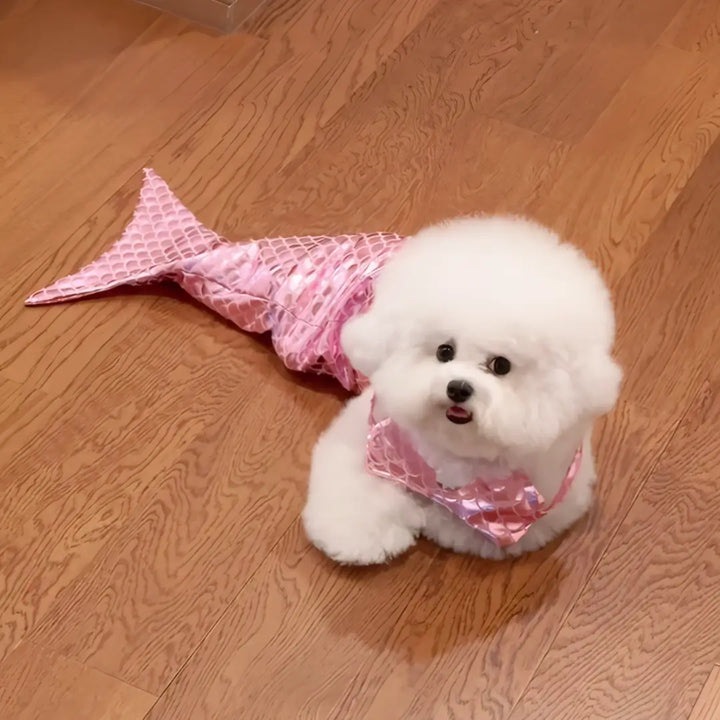
After placing the costume, look at the chest and the small top piece. The clothing should not press into the chest, cover the face, or change breathing. Check from the front and side while the pet lowers the head and turns to look around.
Fasten the costume only enough to keep it in position. Tightening a smaller size until it stays still does not create a good fit. If the chest looks compressed or the pet cannot settle, remove the costume and reassess the measurements or choose a simpler photo accessory.
Watch the tail when the pet moves
The tail-shaped body piece is part of the mermaid effect, so it needs its own movement check. Ask the pet to walk a few steps, turn, sit, and stand. Look for dragging, folding beneath the body, catching on a foot, or shifting when the pet changes direction.
A standing photo can hide a problem that appears when the pet sits or turns. If the tail changes the stride, causes repeated pawing, or makes the pet freeze, do not stretch the session. Remove the outfit while the pet is still calm enough to recover.

Consider body shape and fur
Two measurements can still leave practical questions. A fluffy coat can change how the fabric sits. A rounder chest, longer back, or narrower waist can make a listed dimension feel different in use. Observe where the costume rests rather than judging only from a top-down view.
Leave room for normal breathing and ordinary posture. The costume should not need constant readjustment to stay in place, and it should not be so loose that the tail or fabric becomes a tripping concern. If no listed row accommodates the full body comfortably, another outfit shape is a better answer.
Test the costume before photo day
Try the costume in a quiet familiar room before a party or holiday. Let the pet sniff it, put it on briefly, and reward relaxed behavior. Have the camera ready before the next try so you can finish quickly.
Check walking, sitting, turning, head movement, breathing, and the pet's choice to stay near you. Dogs and cats may need different amounts of time, and a cat that leaves should be allowed to leave. The test is not a performance the pet must pass. It is information about whether this outfit belongs in the planned moment.
Decide what between sizes means
If your measurements sit between rows, compare the complete body set and prioritize comfortable movement. A slightly roomier option may be preferable to one that pulls, but excessive looseness can let the costume slip or catch. The right decision depends on where the extra space appears and how the tail behaves.
Do not use the closure to force a mismatch into place. If one measurement is clearly outside the listed reference or the costume cannot sit without pressure, stop before checkout. A simpler accessory can carry the theme without asking the pet to manage a poor fit.
Inspect the bow and decorative pieces
Before every use, check the scale surface, tail edges, bow, top piece, and fasteners. The product details do not promise chew-proof decoration. If your pet can reach and mouth a piece, supervision needs to be immediate and continuous.
Remove the costume for repeated chewing, scratching, or attempts to strip off the bow or top. Keep it away from an unattended pet after the photo. A costume that looks secure at the start can loosen as the pet moves.
Use the size and fit checklist
- Measure chest girth at the widest point while the pet stands.
- Measure back length from neck base to tail base.
- Compare both numbers with the listed S, M, and L dimensions.
- Use the approximate weight range only as a secondary check.
- Try the costume indoors before the party or photo session.
- Watch walking, turning, sitting, breathing, and tail position.
- Remove the outfit for pressure, slipping, chewing, or distress.
Measure first, then decide if the moment fits
A size row can tell you where to start, but comfort decides whether the costume should be worn. For the complete audience and preparation context, read the photo-ready pet guide. To compare a full look with a lighter option, compare the mermaid costume with a bandana. When your measurements and movement test agree, review the available mermaid costume options.
Common Questions
How should I choose S, M, or L?
Measure chest girth and back length, compare both with the listed dimensions, and use the approximate weight range only as a secondary check.
What if my pet is between sizes?
Prioritize comfortable movement and tail position. Do not tighten a mismatch into place, and consider a simpler accessory if no row fits well.
What should I check after putting it on?
Watch walking, turning, sitting, breathing, and body language, then inspect the tail, bow, top piece, and fasteners.
More Fit Guidance
Review related fit and buying questions for this product.


Whimsical Mermaid Pet Costume for Dogs & Cats
- Mermaid Pet Costume
- For Dogs & Cats
- Photo-Ready Sparkle
- Adjustable Short-Wear Fit
