
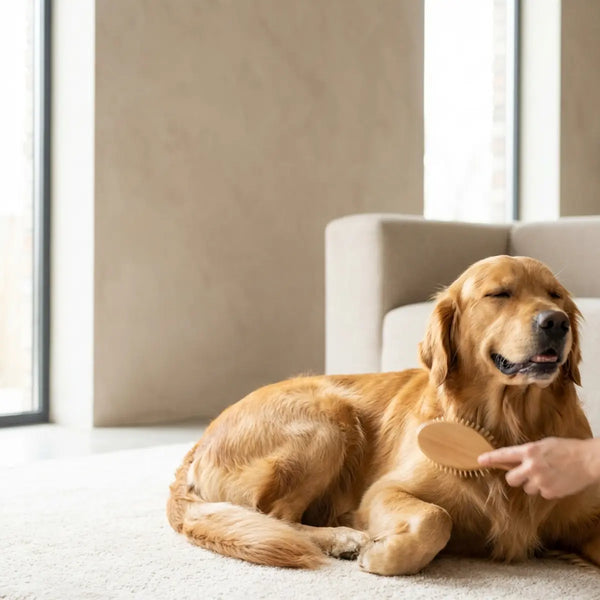


If your dog looks fluffy on top but still has tangles underneath, you’re seeing the most common problem with quick at-home brushing: the brush reaches the surface while compacted hair remains close to the skin.
Line brushing is a grooming technique that separates a dog’s coat into small layers and brushes each section from the skin outward. You part the coat, work through the exposed layer, move the line slightly, and repeat until the whole area has been brushed and checked with a comb. The method is especially useful for long, curly, silky, and dense coats because it helps you find tangles before they become tight mats.
Line brushing is practical for home grooming, but it should be gentle and adapted to your dog’s coat, skin, and tolerance. The technique can help remove loose hair and surface dirt, reduce tangles, and give you a better chance to inspect the skin. It does not replace professional grooming for severe matting, painful areas, skin problems, or dogs that cannot be handled safely.
What is line brushing for dogs?
Line brushing is a coat-separation method in which you brush a dog’s hair in small sections, working from the skin toward the ends instead of brushing only across the visible surface.
The word “line” refers to the narrow part or seam you create in the coat. You begin near the bottom of the dog’s body, lift or hold the hair above that area, and brush the exposed section. Once that section is clear, you create another line slightly higher and repeat the process.
A typical line-brushing sequence looks like this:
- Start with a small area near the skin.
- Hold the unworked coat up and out of the way.
- Brush the exposed section in the direction the coat grows.
- Work gradually through loose tangles instead of pulling hard.
- Run a metal comb through the section to check your work.
- Release a small amount of hair and create the next line.
- Continue until you reach the top of the coat.
The checked grooming standards and university extension guidance support the underlying practices involved: selecting tools for the coat, working through manageable sections, inspecting for mats, detangling gradually, and checking the coat with a comb through to the skin. Those sources do not formally define the salon term line brushing, so it is best understood as a practical home method built from these established grooming steps. You can review the American Kennel Club grooming education standards and Texas A&M’s coat-brushing guidance for the source-supported principles behind the technique.

How is line brushing different from regular brushing?
Regular brushing often means moving a brush over the coat from the outside. That can smooth the top, remove some loose hair, and make the coat look finished while leaving hidden tangles underneath.
Line brushing is slower and more deliberate. It asks you to separate the coat so you can see and reach the layers closer to the skin. The final comb check matters because a coat can feel soft on the surface while still resisting a comb lower down.
This does not mean line brushing has been proven superior to every other brushing method. The available evidence does not include a controlled comparison measuring mat removal, coat breakage, comfort, or finish quality. The practical distinction is that line brushing gives you a more demanding way to verify that you have worked through the coat, rather than judging success by surface appearance alone.
Regular grooming can remove dirt and loose hair, distribute natural oils, reduce tangles, and help you notice changes in the coat or skin. Those benefits apply to grooming generally; the available sources do not establish that line brushing itself treats skin disease or guarantees a salon finish. For broader coat-care planning, see this complete guide to grooming dogs by coat type.
Why does line brushing matter for long and curly coats?
Line brushing matters because long, silky, curly, and dense coats can hide tangles close to the skin, where friction and moisture make them harder to notice.
The most troublesome areas are usually the places where hair rubs against hair, collars, harnesses, bedding, or the ground:
- Behind the ears
- Under the chin
- Around the neck and collar
- Beneath the front legs
- Around the elbows
- In the armpits
- Along the belly and groin
- Around the tail and hindquarters
- Between the toes
- Under clothing or harness straps
VCA Animal Hospitals and the ASPCA both describe coat-specific brushing needs. Long, silky, or curly coats generally require more frequent attention than short coats because they are more prone to tangling and matting. The right schedule still depends on coat density, length, shedding, outdoor activity, moisture, and how well your dog tolerates handling.
Grooming-related problems are also more visible in long-haired dogs in selected service populations. A retrospective analysis of ASPCA programs reported that long-haired dogs were overrepresented in some grooming-related categories, but the study did not measure line brushing or show that a particular home routine prevents those cases. It is useful context for taking hidden mats seriously, not a prevalence estimate for all dogs.
Dense coats can also hold more warmth and moisture in protected areas. A study of 21 Newfoundland dogs measured higher relative humidity beneath the tail and at the ventral neck than at several other coat locations under the study conditions. The study did not test brushing, infection prevention, or line brushing, but it supports a sensible grooming habit: inspect dense, covered, and friction-prone areas rather than focusing only on the visible outer coat.
For a schedule based on coat type, activity, and matting risk, use this practical dog grooming frequency guide.
Which tools do you need for line brushing?
The essential tools are a coat-appropriate brush, a metal comb, a way to hold or separate the coat, and a safe grooming surface. The best tool combination depends on your dog’s coat rather than its breed name alone.
A useful starter kit includes:
- Slicker brush: A brush with fine, angled pins that can help separate curly, wavy, or tangled coats.
- Metal greyhound-style comb: A narrow-tooth or combination-tooth comb used to check whether you have reached through the coat.
- Pin brush: A gentler option for some long, flowing coats and finishing work.
- Bristle brush: More useful for some smooth or medium coats and surface finishing than for deep mat removal.
- Coat-safe detangling spray: Helpful when the product is appropriate for your dog and used according to its label.
- Clips or sectioning bands: Useful for holding unworked hair away from the section you are brushing.
- Non-slip mat: Helps your dog stand or lie comfortably during short sessions.
- Treats: Useful for rewarding calm handling and building a positive routine.

The American Kennel Club, VCA, and ASPCA all frame tool choice around coat type and purpose. Slicker brushes are commonly used for curly coats and tangles, long-tooth combs help with long hair and verification, bristle tools suit some smoother coats, and de-shedding tools are intended for loose undercoat rather than general dematting. A tool designed to remove loose undercoat is not automatically the right tool for a tightly curled coat or a fragile, silky coat.
What makes a brush suitable for your dog?
A suitable brush should let you work through the coat without forcing the pins against the skin. Look for pins or teeth that are smooth, secure, and appropriate for the coat’s texture and density. The handle should give you control without requiring a tight grip.
Test the brush on your own forearm with light pressure. If it feels sharp or scratchy to you, it may be uncomfortable for your dog. This simple check does not prove how the tool will perform in every coat, but it can help you identify an obviously harsh brush before you begin.
| Check | What to look for |
|---|---|
| Pin or tooth finish | Smooth tips without obvious sharp edges |
| Flexibility | Enough give to follow the coat without aggressive scraping |
| Construction | Pins that stay secure during use |
| Size | Small enough to control around legs, ears, and armpits |
| Handle | Comfortable grip that supports light pressure |
| Coat match | Tool suited to the texture, length, and density of your dog’s hair |
There is no checked controlled study showing that a more expensive brush automatically protects coat health or outperforms an inexpensive brush. In practice, an inexpensive brush that matches the coat and is used gently may be more useful than an expensive tool that is too harsh, too large, or poorly suited to the hair.
A survey of 167 clients using a subsidized grooming service found that 91% said at least one supply or support would help them maintain grooming at home, while brushes or combs were the most frequently selected item at 61%, representing 102 participants. The study measured perceived need, not brush performance. Its practical message is clear: owners benefit from understandable tool guidance and access to suitable supplies.
For short maintenance sessions after walks or baths, review the usage guide for the Viva spray-handle massage brush. For supervised post-bath drying and light brushing, the PetPulse Grooming Dryer Brush is a separate maintenance option. Start on a cool setting, keep airflow moving, introduce the tool gradually, and leave severe mats to a professional groomer.
How should you prepare your dog for line brushing?
Prepare your dog by choosing a calm time, checking the coat and skin, gathering the tools first, and deciding how much grooming your dog can comfortably handle in one session.
Do not begin when your dog is wet unless the tool and task are specifically intended for wet coat care. Wet hair can clump, and brushing through compacted or wet tangles can increase pulling. A light post-walk touch-up is different from a full dematting session.
Before brushing:
- Choose a quiet, well-lit area with a stable surface.
- Let your dog sniff the tools.
- Check for redness, sores, swelling, bald spots, unusual hair loss, or painful areas.
- Identify friction zones and existing tangles.
- Decide whether you will work standing, sitting, or lying down.
- Keep treats nearby.
- Start with a small, easy area such as the shoulder or side.
Your dog should be able to move away briefly and reset. A grooming session becomes less useful when your dog is struggling, panting heavily, repeatedly trying to escape, freezing, growling, snapping, or showing other clear signs of distress.
A survey of subsidized grooming-service clients found that 45% reported fear of hurting their pet as a barrier to home grooming, 7% said they could not physically control the pet, and 13% said they had no one to help with grooming. Those figures describe a specific New York City service population and should not be generalized to all dog owners, but they show why clear instructions and realistic handling limits matter.
A veterinary forensic case series examined dogs that died during grooming, bathing, or other pet-service procedures. Its findings come from submitted necropsy cases rather than the general dog population, so they do not estimate ordinary home-grooming risk. The bounded lesson is that handling technique, task fit, and stress deserve serious attention. Stop when brushing becomes unsafe, and use a professional who can assess the situation.
How do you line brush a dog step by step?
The best line brushing technique is gradual: separate a small section, brush from the skin outward, verify with a comb, and move to the next section only after the current one is clear.
-
Start at the lowest accessible section
For a long or curly coat, begin on the lower side of the body or near the rear leg. Hold the upper coat out of the way with your free hand or a soft sectioning clip.
Create a narrow part in the hair. You do not need to expose a large area. A section roughly the width of your brush is easier to control and less likely to overwhelm your dog.
Hand position: Hold the brush in your dominant hand with a relaxed grip. Use your other hand to support or lift the unworked coat. Keep your fingers between the brush and delicate skin when working near the legs, armpits, ears, or belly.
-
Brush the exposed layer from root toward tip
Place the brush into the exposed section close to the skin, but do not press down. Use short, controlled strokes that follow the direction of coat growth.
If the brush catches, pause. Do not increase force immediately. Use your fingers to separate the hair, apply a small amount of suitable detangling product if appropriate, and work from the ends of the tangle toward the roots.
Starting at the skin and dragging through a large tangled mass can pull the skin. Starting only at the tips can leave the root packed. The safer working pattern is to loosen the outer edge of a tangle, then gradually move closer to the skin as the hair separates.
-
Use your free hand as a guard
When brushing a long coat, place your fingers between the brush and the skin where possible. This helps you feel how much hair is being pulled and gives you more control around sensitive areas.
Your free hand also stabilizes the coat. Avoid holding the hair so tightly that you create tension at the skin. The goal is to separate and support the hair, not stretch it.
-
Move the line a small distance
Once the exposed section is smooth, release a thin layer of hair from above it. Create a new line slightly higher and repeat the brushing process.
Work in a consistent pattern:
- Lower side
- Middle side
- Upper side
- Back and shoulder
- Chest
- Legs
- Belly and friction areas
- Tail and hindquarters
- Head and ears
You can change the order if your dog becomes uncomfortable. Begin with easy areas and leave sensitive locations for later, when your dog is settled. Short successful sessions teach your dog more than one exhausting session that ends with a struggle.
-
Check each section with a metal comb
After brushing a section, run a metal comb through it from near the skin toward the ends. The comb should pass through with light resistance. If it stops, you have found a remaining tangle.
Do not treat the comb as a test you need to force. Use it as information. Return to the brush or your fingers, loosen the tangle, and check again.
The comb check is one of the most important differences between surface brushing and a more thorough line-brushing routine. Texas A&M guidance recommends checking through the hair to the skin after brushing. That supports the comb as a practical verification tool, although it does not prove that every coat has been completely cleared.
-
Continue until the whole coat is checked
Keep sections small enough that you can see what you have completed. If your dog becomes restless, stop at a natural point and continue another day.
A complete session may take longer for a dense, long, or curly coat. Time is not the goal. Comfortable coverage and reliable checks are the goal.
For doodle coats, the groomer’s daily doodle mat-prevention routine provides another coat-maintenance approach built around small sections, friction-zone checks, and steel-comb verification.
-
Finish with a light surface pass
Once the coat passes the comb check, use a light brush pass to settle the hair. Avoid repeatedly brushing a section that is already clear. Excessive strokes can irritate the skin or make your dog impatient.
If the goal is a fluffy appearance, finish gently after the coat is clear. Appearance should come after comfort and verification.

Can you line brush a Goldendoodle at home?
Yes, many owners can line brush a Goldendoodle at home when the coat is manageable, the dog accepts handling, and the owner works in small sections without forcing tangles.
Goldendoodle coats vary widely. Some are loose and wavy, some are tightly curly, and others combine different textures across the body. Coat length and density also change how difficult the work will be. A routine that works for a short, wavy coat may be inadequate for a long, dense, curly coat.
For an instructional visual, imagine a Goldendoodle with a long, wavy coat after a muddy walk. Before brushing, the outer layer appears fluffy, but the hair behind the ears, beneath the collar, and around the armpits feels slightly compacted. After the coat is separated into narrow lines, brushed from the skin outward, and checked with a metal comb, those areas lie more freely and the coat looks more even.
This is a demonstration example, not a published before-and-after case or measured proof of line-brushing effectiveness. The available evidence does not include a documented Goldendoodle case attributing a specific coat outcome to line brushing.
For doodles, pay particular attention to:
- Behind the ears
- Under the collar or harness
- Around the mouth
- Under the front legs
- At the elbows
- Around the tail base
- Between the back legs
- Along the belly
- Where the coat becomes wet after swimming or rain
A useful habit is to perform a short friction-zone check between full brushing sessions. Touch and gently separate those areas even when you do not have time for a complete groom.
How often should you line brush a dog?
Brush often enough to keep the comb moving through the coat and adjust the schedule when your dog’s coat, lifestyle, or moisture exposure changes.
There is no validated universal frequency chart for every breed and coat. Veterinary guidance offers broad examples: short or dense coats may need less frequent brushing, while long, silky, and curly coats may need daily attention. Treat those recommendations as starting points rather than fixed rules.
| Coat or situation | Practical starting point | What to check |
|---|---|---|
| Short, smooth coat | Weekly or as needed | Loose hair, dirt, skin changes |
| Short, dense double coat | Several times weekly during shedding | Undercoat, collar area, rear legs |
| Medium or feathered coat | Several times weekly | Ears, legs, tail, friction zones |
| Long, silky coat | Frequent brushing, often daily | Behind ears, armpits, belly, tail |
| Curly or doodle-type coat | Frequent small-section checks, often daily | Whether the comb reaches the skin |
| Wet or muddy lifestyle | Quick checks after drying, plus regular full sessions | Damp areas and compacted hair |
| Existing tangles | Short, targeted sessions | Pain, skin tightness, and worsening mats |
Your schedule is working when the coat can be combed through without repeated snags and your dog remains comfortable. If you repeatedly discover tight tangles, increase the frequency, shorten the coat with professional help, or review your tools and technique.
Moisture deserves special attention. Dry your dog thoroughly after swimming, rain, or bathing according to the coat’s needs, and inspect areas that stay covered or compressed. A damp, dense coat can be harder to separate and easier to overlook.
How do you brush out a matted dog safely?
You can work on a small, loose tangle at home, but severe, painful, skin-tight, or widespread mats should be handled by a professional groomer or veterinarian.
Begin by identifying what you are dealing with:
- Loose tangle: Hair separates with your fingers and a few gentle brush strokes.
- Small mat: A compact knot that remains away from the skin and can be loosened gradually.
- Tight mat: A dense mass close to the skin that pulls when touched.
- Widespread matting: Multiple compacted areas across the body, often requiring clipping.
- Painful or irritated area: A mat associated with redness, sores, swelling, odor, or sensitive behavior.
For a loose tangle, hold the hair near the skin so movement does not pull the dog. Work at the outer edge with your fingers or a suitable tool. Begin at the ends and gradually move inward. Keep the session short.
Do not use scissors to cut through a mat that is close to the skin. Skin can be pulled into the mat and is easy to cut accidentally. Do not keep brushing through a dog’s pain because the coat looks fixable.
Seek veterinary or professional grooming help when you see:
- Red or irritated skin
- Open sores
- Bald spots
- Unusual hair loss
- Swelling, discharge, or strong odor
- Severe or skin-tight mats
- A dog that cries, snaps, panics, or cannot be safely controlled
- Matting across a large portion of the body
- A sudden change in coat or grooming tolerance
The ASPCA advises veterinary consultation for several of these skin and coat signs. Professional grooming guidance also includes mat inspection and decisions about clipping or shaving when mats cannot be safely removed. For a focused review of common errors, read how to avoid DIY dog-grooming mistakes.
What are the most common line-brushing mistakes?
The most common mistakes are brushing only the surface, using the wrong tool, working through pain, skipping the comb check, and trying to complete too much in one session.
Brushing faster instead of brushing smaller sections
Large strokes across a thick coat feel efficient, but they often smooth the outer hair without reaching the lower layers. Reduce the section size and slow down.
Pressing harder when the brush catches
Pressure can make a tangle tighter and increase discomfort. Pause, support the coat, loosen the outer edge, and work gradually.
Using a de-shedding tool for every coat problem
De-shedding tools have a specific purpose. They are not a universal replacement for a slicker brush, pin brush, or comb. Match the tool to the coat and task.
Skipping the comb
A brush can make the coat feel soft without proving that the lower layer is clear. Use the comb as a check, especially around the ears, armpits, tail, and collar area.
Brushing a dirty or damp coat without a plan
Dirt and moisture can make the coat harder to separate. Brush before bathing when the coat is dry and reasonably free of debris, then use the appropriate drying and finishing routine after bathing.
Ignoring your dog’s signals
A dog that turns away, pulls back, freezes, pants, trembles, growls, or repeatedly tries to leave is giving you useful information. Pause and reduce the difficulty. Reward calm behavior and build duration slowly.
Treating every mat as a home project
A professional groomer’s value is not limited to making a coat look attractive. A groomer can recognize when a mat is too close to the skin, when clipping is safer than dematting, and when a skin problem needs veterinary attention.
How can you make line brushing more comfortable?
Make line brushing comfortable by using light pressure, supporting the coat, rewarding cooperation, and stopping before your dog becomes overwhelmed.
A calm routine usually develops through repetition:
- Touch the dog with the brush without brushing.
- Reward relaxed behavior.
- Brush one or two strokes in an easy area.
- Reward again.
- Gradually increase the number of strokes.
- Add more sensitive areas only when the earlier steps are easy.
- End while your dog is still coping well.
Use a stable surface and keep your body position comfortable so you do not accidentally pull or twist the coat. If a second person is needed, that person should support calm positioning rather than restrain the dog aggressively.
Keep sessions short enough that your dog can recover quickly. For some dogs, two five-minute sessions are more productive than one twenty-minute session. For others, a longer quiet session works well. Watch the dog in front of you.
The purpose of home grooming is to maintain the coat between professional appointments, not to prove that you can complete every grooming task alone. If the coat or the dog’s behavior exceeds your skill level, referral is part of responsible care.
Frequently Asked Questions
Can line brushing prevent all mats?
No. It can help you find and loosen developing tangles, but mats can still form because of coat texture, moisture, friction, shedding, outdoor activity, grooming gaps, or skin and health changes. Frequent checks and a coat-appropriate schedule reduce surprises without guaranteeing a mat-free coat.
Should I line brush before or after bathing?
For most long, curly, or tangled coats, work through manageable tangles before bathing. Water can tighten or compact some tangles. After bathing, dry the coat carefully and use a suitable brush or comb for the drying stage. Severe mats should be assessed before you bathe the dog.
Is a slicker brush enough for line brushing?
A slicker brush may be useful for separating and brushing many curly or wavy coats, but a metal comb is important for verification. The right combination depends on coat texture, density, length, and skin sensitivity.
How do I know whether I reached the skin?
You do not need to scrape or press against the skin. After brushing a small section, gently pass a metal comb through it from near the skin toward the ends. If the comb stops, investigate that area. A comb pass is a practical check, not a guarantee that every tangle has been removed.
Is line brushing safe for every dog?
No. The technique should be adapted or stopped when the dog has painful mats, irritated skin, open sores, unusual hair loss, severe anxiety, or behavior that makes brushing unsafe. In those situations, contact a professional groomer or veterinarian.
Build a simple line-brushing routine
Start with one small section, one suitable brush, and one calm session. Separate the coat, brush from the skin outward, check with a comb, and stop before your dog becomes distressed.

Over time, line brushing can make coat maintenance more predictable. You may notice tangles earlier, understand your dog’s friction zones, and arrive at professional grooming appointments with fewer surprises. The routine also gives you regular opportunities to inspect the coat and skin for changes.
Long-haired, curly, silky, and dense coats usually need more frequent attention than short coats, but your dog’s actual coat condition should guide the schedule. Keep the work gentle, take small sections, and treat painful or widespread matting as a reason to get help.
For more practical guidance, continue with the Bichon grooming schedule for preventing mats and subscribe to monthly grooming tips for coat-care reminders, handling ideas, and tool guidance. A consistent home routine can help support your dog’s comfort and appearance between salon visits.
