




Feline feeding comfort
A cat can stare at a full bowl, walk away, and leave you wondering whether the food has suddenly become unacceptable. Some cats paw a few pieces onto the floor, eat only from the edge, or seem interested until their face reaches the dish. It is easy to call this picky eating. It is also easy to worry that something is medically wrong.
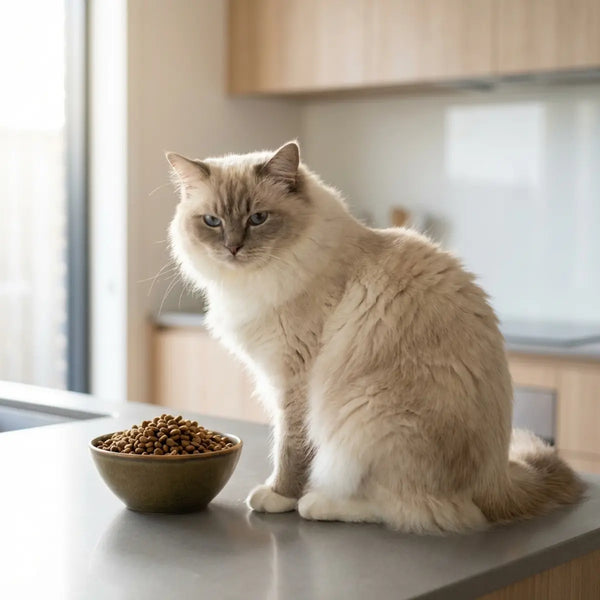
The bowl itself can be part of the picture, but “whisker fatigue” needs a careful explanation. The term is commonly used for possible discomfort or stress caused by repeated whisker contact with a dish. Feline whiskers are specialized sensory structures, so a shallow, wide dish may be more comfortable for some cats. Yet current research does not establish whisker fatigue as a formal disease, validate a specific symptom checklist, or prove that every deep bowl causes sensory overload.
A flat feeding plate is best treated as a simple preference trial. Offer it while keeping the food, portion, feeding location, and routine as consistent as possible. Watch whether your cat approaches the food more willingly, eats with less interruption, or chooses the new dish when both options are available. If your cat stops eating or eats much less than usual, contact a veterinarian rather than assuming the bowl is the cause.

What is whisker fatigue in cats?
Whisker fatigue is a popular term for possible discomfort or stress associated with repeated stimulation of a cat’s whiskers. It describes a feeding hypothesis, not a confirmed veterinary diagnosis. The idea is that a narrow or deep bowl may repeatedly press against the whiskers as a cat reaches for food, making the feeding experience unpleasant for that individual cat.
The phrase sounds more settled than the evidence actually is. A 2021 peer-reviewed feeding study described “whisker stress” as a popular cultural term and noted that little evidence-based clinical research had tested its existence or effect in domestic cats. The researchers did not treat it as an established disease or provide diagnostic criteria. You can read the Journal of Feline Medicine and Surgery study on whisker stress for the full study design and findings.
That distinction matters because a cat may dislike a dish for many reasons. The bowl may slide, smell strongly, be difficult to clean, sit in a noisy location, or force the cat to compete with another animal. Dental pain, nausea, gastrointestinal disease, stress, and other health problems can also change eating behavior.
A practical way to think about whisker fatigue is this:
It is a reasonable comfort hypothesis to test at home, not a diagnosis to make from behavior alone.
The safest response is therefore modest. You can make the feeding setup easier and observe your cat’s response, while keeping medical causes in view.
Why do cats have whiskers?
Whiskers, also called vibrissae, are specialized facial hairs connected to highly innervated follicle-sinus complexes. That means the tissue around each whisker contains sensory nerve structures that send information to the nervous system. Cats use this information as part of environmental assessment, including close-range touch and spatial awareness.
Research on feline whisker anatomy supports their sensory specialization. Comparative microscopic studies have examined the nerve supply and structure of cat vibrissal follicle-sinus complexes. The work helps explain why whiskers are more than ordinary hair, but it does not show that contact with a food bowl automatically causes pain, stress, or overload. The anatomical research on feline vibrissae and related confocal study of cat whisker innervation support the sensory biology behind the discussion.
A cat’s whiskers also help it gather information in dim or confined spaces. They can detect nearby surfaces and movement, helping the cat judge its surroundings. That sensory role is one reason many owners are cautious about putting pressure on them.
Still, sensory sensitivity differs from proven feeding distress. The fact that a structure is sensitive does not tell us how every cat experiences contact with a dish. Some cats may ignore whisker contact. Others may prefer more open access to food. Your cat’s behavior can guide a low-risk preference trial, but it cannot confirm a medical condition.
What are the signs your cat hates their bowl?
Commonly reported observations include hesitation at the dish, eating from the outer rim, dropping food, pawing food onto the floor, or choosing food offered on a flatter surface. These behaviors may suggest that the feeding setup deserves attention, but they are not validated signs specific to whisker fatigue.
The available feeding study measured food eaten, food dropped, time spent at the bowl, and dish preference. It did not validate a checklist covering pacing, face pawing, short eating bursts, or inconsistent eating. Those observations can still be useful. Record them carefully and share them with your veterinarian if the change persists.
Watch for patterns rather than one isolated action:
- Your cat approaches the food, hesitates, and walks away repeatedly.
- Food remains in the center of a deep bowl while the cat tries to reach it from the edge.
- Your cat paws pieces onto the floor and eats them there.
- Your cat eats more readily from a plate, saucer, or other open surface.
- Your cat appears interested in food but stops after a few bites.
- Your cat chooses one dish when two dishes containing the same food are offered.
- Your cat’s behavior changes only in one feeding location or around another animal.
None of these observations proves whisker fatigue. They are clues about the whole feeding experience.

Can pawing food out of a bowl indicate whisker fatigue?
It can be a reason to test a different dish, but it cannot confirm whisker fatigue. A cat may paw food out because the bowl is deep, because the food is easier to see on the floor, because the dish moves, or because the cat has learned a preferred eating routine. Some cats also use their paws naturally when handling food.
The same caution applies to eating from the edge. A cat may avoid the middle because its nose reaches the food more easily from the rim, or because the food has shifted there. The behavior becomes more informative when it appears consistently and changes after one controlled adjustment.
Try observing three things:
- Approach: Does your cat walk toward the dish willingly?
- Feeding pattern: Does your cat eat steadily, pause often, or remove pieces?
- Preference: When the same food is offered in two different dishes, which one does your cat choose?
Keep the comparison fair. Use the same food, similar portions, the same room, and dishes placed a short distance apart. Change one feature at a time. If you switch the food, location, dish, and feeding schedule together, you will not know which change affected the behavior.
What does a cat with possible bowl discomfort look like?
A cat experiencing possible bowl discomfort may show avoidance or altered feeding behavior, but there is no agreed clinical profile. The most useful information is the pattern you can document:
| What you observe | What it may suggest | What it does not prove |
|---|---|---|
| Food is moved to the floor before eating | The cat may prefer a more open eating surface | That whisker contact caused the behavior |
| Eating happens only from the rim | The center may be harder or less comfortable to reach | That the cat has whisker fatigue |
| The cat chooses a plate over a deep bowl | The plate may suit the cat’s individual preference | That the plate improves health |
| The cat refuses all food | Illness, pain, nausea, stress, or another serious problem must be considered | That the bowl is the cause |
| The cat eats normally in a quiet room but not near other pets | Social or environmental pressure may be involved | That whiskers are the main issue |
The table is a decision aid, not a self-diagnosis tool. Look for changes in total food intake, energy, weight, thirst, vomiting, stool, grooming, and general behavior.
How can you tell whisker fatigue from picky eating or illness?
The key difference is whether your cat is selective about the dish or is losing interest in food more broadly. A cat that eats normally from a plate but avoids one deep bowl may be expressing a feeding preference. A cat that refuses several foods and eats less overall needs medical attention.
Picky eating is also a loose everyday label. It can describe normal food preferences, learned habits, stress, or an early sign of disease. It does not explain why the change occurred.
Medical causes of reduced appetite include dental disease, oral pain, gastrointestinal problems, systemic illness, and psychological or environmental stress. The American Animal Hospital Association and American Association of Feline Practitioners identify dental disease, oral masses, and orofacial pain as possible causes of pain and reduced appetite. Their 2021 feline life stage guidelines also emphasize that cats generally prefer to eat individually in a quiet location where sudden movement, other animals, and activity do not startle them.
Cornell’s veterinary guidance on feline anorexia and appetite loss explains that sustained appetite loss can have many causes and warrants veterinary assessment. Cornell notes that appetite loss can have a severe effect on a mature cat if it continues for as little as 24 hours, although the right response depends on the cat’s age, health, symptoms, and overall situation.
Seek veterinary advice promptly if your cat:
- Eats nothing or almost nothing for a day.
- Has a sudden, marked reduction in food intake.
- Shows vomiting, diarrhea, weakness, hiding, breathing changes, or unusual lethargy.
- Drools, struggles to chew, drops food repeatedly, or paws at the mouth.
- Has weight loss, increased thirst, or changes in urination.
- Seems painful when approaching, chewing, or swallowing food.
- Is a kitten, senior cat, or cat with a known medical condition.
A bowl change can be tried alongside appropriate care for a mild preference issue. It should not delay an examination when appetite loss is sudden, sustained, or accompanied by other symptoms.
A hypothetical example: when a bowl change raises a useful question
Imagine a cat named Juniper who has always eaten dry food. Over two weeks, Juniper begins taking a few pieces from the bowl, carrying them to the floor, and returning later. Her owner assumes she has become bored with the food. When the same food is placed on a wide, shallow plate, Juniper eats from it immediately.
That pattern would justify keeping the plate and monitoring Juniper. It would not prove that whisker fatigue caused the earlier behavior. The improvement could reflect the plate’s shape, its stability, its cleanliness, the owner’s closer observation, or another change that happened at the same time.
This is why a simple feeding log helps. Record:
- Food offered and approximate amount eaten.
- Dish type and location.
- Time spent near the food.
- Whether food is moved or dropped.
- Any vomiting, stool changes, mouth discomfort, or unusual behavior.
- Body weight when you can measure it consistently.
A log turns a vague impression into useful information for both you and your veterinarian.

Do flat feeding plates help cats with whisker fatigue?
A flat or shallow feeding plate may help an individual cat by reducing contact between the face and the dish sides. It may also make food easier to see and reach. The evidence supports offering this as a preference experiment, not promising that it will prevent whisker fatigue or improve appetite in every cat.
The strongest direct evidence is a prospective study of presumed healthy indoor cats that normally ate dry food. Thirty-eight cats completed the protocol. Each cat used its normal dish and then transitioned over seven days to a commercially advertised whisker-friendly dish. The researchers measured food eaten, food dropped, time at the bowl, and dish preference.
The dish change did not produce a statistically significant improvement in the measured feeding outcomes. Cats ate an average of 0.22 ± 0.07 cups from the whisker-friendly dish compared with 0.21 ± 0.07 cups from their normal dish. They spent 198 ± 75 seconds at the whisker-friendly dish and 209 ± 68 seconds at the normal dish. The amount of food dropped also did not decrease in the study protocol.
Preference was different from performance. When the two dishes were offered, 24 of 38 cats preferred the whisker-friendly dish, 9 preferred the normal dish, and 5 showed no preference. The study estimated a 0.74 probability that a cat would prefer the whisker-friendly dish within that sample.
Those results offer a useful middle ground. Some cats may prefer an open, shallow design even when a group-level study does not show greater intake or faster eating. Preference is meaningful for daily comfort, but it is not the same as proof of lower stress, pain relief, improved health, or a confirmed whisker problem.
The study also had limits. It involved a small sample of presumed healthy indoor cats, focused on dry food, used owner-recorded videos, was not blinded, and did not measure direct whisker contact, physiological stress, pain, or a validated whisker-fatigue symptom score. The dishes differed in several design features, so the results cannot identify one universally correct plate.
Which shallow cat dish features should you look for?
Choose a dish that gives your cat open access to the food and is easy for you to clean. There is no evidence in the supplied research establishing one ideal diameter, depth, material, height, or shape for every cat.
Useful features to consider include:
- A wide, open surface: Food should be easy to reach without forcing the face into a narrow cavity.
- Low sides: A shallow rim may reduce contact with the cheeks and whiskers.
- A stable base: The dish should stay in place while your cat eats.
- A smooth, washable surface: Scratches and residue can make cleaning harder.
- Low odor: Strong smells from food, soap, or materials may affect acceptance.
- A size that fits the cat and portion: The food should not be crowded into a small central pile.
- A comfortable location: Place the dish away from litter boxes, loud appliances, heavy foot traffic, and other pets that may interrupt the meal.
Material deserves separate attention. Stainless steel, ceramic, and other washable surfaces can work well when they are intact and cleaned regularly. A dish with chips, deep scratches, residue, or a persistent odor is a poor choice regardless of its whisker clearance. For related hygiene considerations, see why bowl material matters for feline chin acne.
Elevated dishes are sometimes marketed as a solution for feeding comfort, but the checked evidence does not establish a universal benefit from elevation. Older cats or cats with mobility limitations may find a particular height easier, while another cat may prefer food at floor level. Let your cat’s posture and behavior guide the choice.
How do you test a whisker-friendly bowl at home?
The most useful home trial changes one factor at a time and tracks what happens. A flat plate can be part of the test, but so can a quieter location, a more stable surface, or a cleaner dish.
A practical five-day feeding trial
- Observe the current setup. Offer your cat’s usual food in the usual dish. Note the portion, how much is eaten, how long your cat stays near the dish, and whether food is moved to the floor. Avoid changing the food or schedule on this day.
- Prepare the alternative. Use a clean, shallow plate or wide dish with a stable base. Place it near the usual feeding area, but leave enough space that your cat can approach it without bumping into the original dish. Offer the same food and a similar portion.
- Keep the surroundings steady. Repeat the same arrangement. Watch from a distance rather than hovering. Some cats eat more comfortably when people, children, or other animals do not stare or move close by.
- Compare preference carefully. If your cat accepts both dishes, place small, equal portions of the same food in each. Keep the positions consistent for one trial, then switch positions in a later trial. This reduces the chance that your cat is simply choosing the familiar side of the room.
- Review the pattern. Ask whether your cat approaches one dish sooner, eats more steadily, drops less food, or returns to the dish more readily. Also check whether total daily intake has stayed adequate.
Do not force your cat to use the new dish. A preference trial works because the cat can show a choice. If the cat ignores the plate, return to the familiar dish and try a different shallow design later.
For broader guidance on portions, food transitions, feeders, and enrichment, use this feeding enrichment and portion routine guide. A puzzle feeder or slow feeder may be useful for enrichment, but those tools solve a different problem from giving the face more open space around the food.
What improvement should you expect?
Improvement may look small. Your cat may approach without hesitation, eat more calmly, stop carrying food away, or choose the shallow dish when both are available. You may also see no change. That result is useful because it suggests the bowl may not be the main factor.
Avoid judging the trial only by speed. Eating faster is not automatically better. Focus on adequate intake, relaxed behavior, normal body condition, and the absence of pain or illness signs.
If the change appears to help, keep the setup consistent for several days and continue monitoring total food intake. If the improvement disappears, consider other factors such as location, household activity, food freshness, dish cleanliness, social pressure, or an emerging medical problem.

What other feeding changes can make meals easier?
Dish shape is only one part of a cat’s feeding environment. The feeding area can influence whether your cat feels safe enough to eat.
Cats generally prefer individual feeding in a quiet location. In a multi-cat home, separate dishes may reduce competition and allow each cat to eat without being watched or interrupted. Place food away from litter boxes and high-traffic areas. Keep children and dogs from crowding the dish.
A consistent routine can also help. Offer food at predictable times, measure portions consistently, and avoid changing several variables at once. Fresh water should be available in a location your cat uses comfortably. If your cat’s appetite or hydration habits change, the senior cat hydration guide provides related guidance on bowl placement, shallow wide dishes, and signs that deserve veterinary attention.
Clean the feeding surface regularly. Remove leftover wet food according to safe food-handling practice, wash the dish, and rinse away soap residue. Replace dishes that have cracks, chips, rough scratches, or odors that remain after washing.
A cat that eats from the edge of a bowl may need a different surface. A cat that refuses food in a busy kitchen may need privacy. A cat that seems hungry but cannot chew comfortably may need an oral examination. Observing the complete pattern prevents one appealing explanation from crowding out the others.
Frequently Asked Questions
Is whisker fatigue a real medical condition?
Whisker fatigue is not established by the checked evidence as a validated feline disease or formal diagnosis. It is a popular term used to describe possible discomfort or stress associated with whisker stimulation. A shallow dish may suit an individual cat, but the term should not be used to explain persistent appetite loss without considering medical causes.
Can whisker fatigue make a cat stop eating?
A bowl preference may contribute to feeding avoidance in some cats, but current evidence does not prove that whisker contact causes cats to stop eating. A cat that refuses food, eats very little, loses weight, or shows other symptoms needs veterinary assessment.
Are flat plates better than bowls for every cat?
No. Flat plates may be preferred by some cats, while others may accept a shallow bowl or their existing dish. The available study did not establish a universal best depth, width, material, or elevation. Choose a stable, clean, open surface and let your cat’s response guide you.
How can I tell whether my cat prefers a new dish?
Offer the same food in the current dish and the alternative dish under similar conditions. Watch which dish your cat approaches, how steadily your cat eats, whether food is moved, and whether the choice remains consistent after the dish positions are switched. Preference does not prove a medical benefit, but it can guide a comfortable home setup.
Should I change my cat’s food before changing the bowl?
If your cat is eating normally but appears uncomfortable with the dish, testing a shallow or wide alternative is a reasonable first adjustment. If your cat’s total intake has dropped, the change is sudden, or other symptoms are present, speak with a veterinarian before treating the issue as a food or bowl preference.
A more comfortable feeding setup starts with observation
Whisker fatigue is best understood as a possible explanation for bowl-related feeding discomfort, not a confirmed diagnosis. Cats have highly specialized whiskers, and some may prefer eating from a wide, shallow surface that gives the face more room. Yet the current feeding evidence found no group-level improvement in food eaten, time at the dish, or food dropped, even though more cats in the study preferred the whisker-friendly dish.
That combination supports a sensible approach: make a low-risk dish change, keep the comparison fair, and watch your cat’s whole pattern. A flat feeding plate may be a useful comfort option, but it should never replace attention to appetite loss, pain, illness, stress, or changes in the feeding environment.
If you are comparing dishes, choose one that is shallow, stable, easy to clean, and comfortable for your cat’s portion size. For more practical feline wellness guidance, explore the related feeding resources above and subscribe for future advice on comfortable, observant cat care.
